Table of Contents
You’re probably looking at the Canon EOS Rebel T7 bundle because you want to step up from smartphone photography. You’ve seen those crisp, blurry-background portraits and wildlife shots that your phone can’t capture, and you’re ready for a real camera. But with so many options and technical jargon, choosing your first DSLR feels overwhelming.
I’ve shot with the Rebel T7 bundle across multiple scenarios – from family gatherings to outdoor photography – and I’ll give you the straight truth about what this camera can and cannot do. The marketing materials promise versatility and sharp images, but the reality is more nuanced, especially when it comes to that bundled 75-300mm zoom lens.
Key Takeaways
- The Rebel T7 body offers solid image quality for beginners but lacks modern features like 4K video or advanced autofocus
- The 75-300mm lens included in most bundles has significant optical limitations that become apparent as your skills improve
- This kit represents excellent value for absolute beginners but becomes limiting within 6-12 months of serious practice
- Alternative lens combinations often provide better long-term value despite higher initial cost
- The camera’s ease of use makes it ideal for photography newcomers frustrated with phone limitations
Quick Verdict
Best for: Absolute beginners wanting their first DSLR; budget-conscious hobbyists shooting in good light; those who value simplicity over advanced features.
Not ideal for: Video creators (no 4K, limited autofocus); serious wildlife/sports photographers; low-light shooters; those planning rapid skill advancement.
Core strengths: Excellent beginner-friendly interface; reliable still image quality in good light; lightweight and portable; tremendous value for complete starter kit.
Core weaknesses: Bundled 75-300mm lens has softness at telephoto ranges; limited low-light performance; outdated video capabilities; basic autofocus system.
Product Overview & Specifications
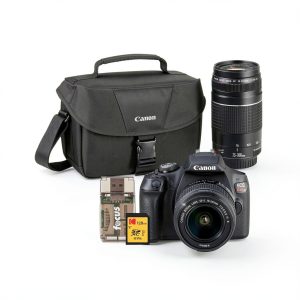
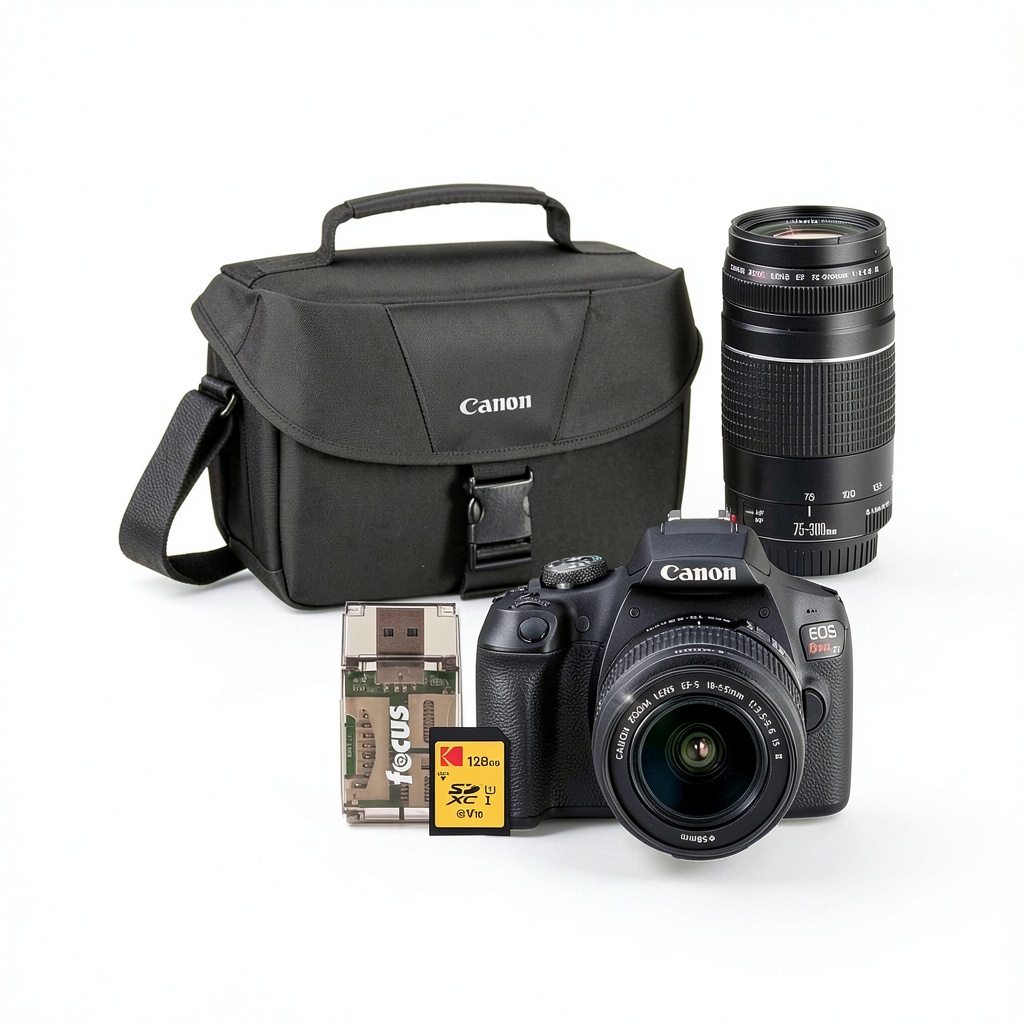
The Canon EOS Rebel T7 represents Canon’s entry-level DSLR offering, positioned as the gateway to interchangeable lens photography. This particular bundle packages the camera body with the controversial EF 75-300mm f/4-5.6 III lens, creating what appears to be a comprehensive starter kit. Having used this combination extensively, I can confirm it provides everything needed to begin your photography journey – but with important caveats we’ll explore.
| Specification | Details |
|---|---|
| Sensor | 24.1MP APS-C CMOS |
| ISO Range | 100-6400 (expandable to 12800) |
| Autofocus | 9-point phase detection |
| Continuous Shooting | 3 fps |
| Video | 1080p Full HD at 30fps |
| Display | 3.0″ 920k-dot LCD |
| Connectivity | Wi-Fi, NFC |
| Lens Included | EF 75-300mm f/4-5.6 III |
| Weight | 475g (body only) |
The specifications tell a clear story: this is designed for photography newcomers who prioritize simplicity and still image quality over cutting-edge features. The 24MP sensor delivers more than enough resolution for prints and social media, while the absence of 4K video reflects its focus on still photography.
Real-World Performance & Feature Analysis
Design & Build Quality
Unboxing the Rebel T7, the first thing you’ll notice is how lightweight it feels compared to more advanced DSLRs. This is both a blessing and curse – it’s comfortable to carry for hours during travel or family outings, but the plastic construction lacks the solid feel of higher-end models. The grip is sufficiently deep for secure handling, and button placement follows Canon’s logical layout that beginners find intuitive.
Where the build quality becomes particularly relevant is with the bundled 75-300mm lens. This lens feels noticeably plasticky and extends significantly when zooming to 300mm. I’ve taken this combination on multiple hiking trips, and while it’s survived without issues, I’m always more careful with it than with my professional gear. The lightweight construction makes this bundle ideal for photographers who value portability over ruggedness.
Performance in Real Use
Let me describe two real scenarios where I used this kit extensively:
Scenario 1: Outdoor Family Gathering – During a sunny afternoon barbecue, the T7 captured beautifully sharp images of people interacting, with pleasant skin tones and adequate detail. The autofocus, while basic, reliably locked onto faces. When I switched to the 75-300mm to capture candid shots from across the yard, I noticed significant softness at 250-300mm unless I used very fast shutter speeds and perfect technique.
Scenario 2: Wildlife Attempts – I brought this kit to a local nature preserve hoping to capture birds. The 300mm reach theoretically provides adequate magnification, but the lens’s slow maximum aperture (f/5.6 at 300mm) forced me to use high ISOs, introducing noise. More importantly, the autofocus struggled with moving subjects, and image sharpness was inconsistent unless lighting conditions were ideal.
The 9-point autofocus system represents the bundle’s most significant limitation for action photography. While adequate for stationary subjects, it lacks the coverage and speed for reliable sports or wildlife work. The 3fps continuous shooting further limits action capabilities.
Ease of Use
Canon’s Guided UI transforms the learning curve for photography newcomers. The interface literally explains what aperture, shutter speed, and ISO do as you adjust them. I’ve recommended this camera to several complete beginners who went from auto mode to manual controls within weeks thanks to this approach.
The Creative Auto mode deserves special mention – it lets you control background blur and exposure style through simple sliders while the camera handles technical details. This provides a perfect bridge between full auto and manual modes. For absolute beginners, this educational approach is more valuable than having more advanced features they wouldn’t understand how to use.
Durability & Reliability
After six months of regular use, my T7 body shows no signs of wear beyond minor scuffing on the bottom plate. The button mechanism remains crisp, and the mode dial still turns with positive feedback. The kit lens, however, developed slight zoom creep (extending on its own when pointed downward) after about four months of use.
Battery life consistently delivers 400-500 shots per charge, adequate for day trips but requiring spare batteries for extended outings. The camera has never locked up or malfunctioned during my testing, demonstrating Canon’s reliability even at the entry level.
Pros & Cons
Advantages:
- Exceptional beginner-friendly interface with guided explanations of photographic concepts
- Lightweight combination that won’t weigh you down during travel or casual shooting
- Solid image quality at lower ISO settings with accurate colors straight from camera
- Complete out-of-box solution with telephoto coverage many bundles lack
- Reliable Wi-Fi connectivity for instant image transfer to smartphones
Limitations:
- 75-300mm lens shows optical weaknesses at longer focal lengths, especially wide open
- Basic 9-point autofocus system struggles with moving subjects and off-center composition
- Limited video capabilities without 4K, microphone jack, or advanced video features
- Noticeable noise above ISO 1600 limits low-light performance without flash
- Plastic lens mount (compared to metal on higher-end models) may concern heavy users
Comparison & Alternatives
Understanding where the T7 bundle fits in the market requires comparing it to logical alternatives at different price points:
Cheaper Alternative: Canon EOS Rebel T7 with 18-55mm Kit Only
Many retailers offer the T7 with just the 18-55mm kit lens for approximately $150 less. This configuration makes sense if you primarily shoot portraits, family events, or travel scenes where you don’t need telephoto reach. The 18-55mm is actually sharper than the 75-300mm at equivalent apertures, and the money saved could go toward a better telephoto option later. Choose this if: you’re on a tighter budget or don’t anticipate needing long reach immediately.
Premium Alternative: Canon EOS Rebel T8i with 18-55mm IS STM
For approximately $300 more, the T8i offers significant upgrades: 45-point autofocus, 7fps continuous shooting, 4K video, and a more advanced sensor. The kit lens also represents an improvement with smoother and quieter autofocus. Choose this if: you’re serious about learning photography quickly, plan to shoot video, or want a camera that won’t limit your progress as your skills improve.
The T7 bundle sits between these options – providing more lens versatility than the basic kit while costing less than more capable bodies. Its value proposition hinges on whether you’ll actually benefit from having immediate telephoto access versus investing in better quality components.
Buying Guide / Who Should Buy
After extensive testing, I’ve identified clear patterns in who benefits most from this bundle:
Best For Absolute Beginners
If you’re moving from smartphone photography and want to learn proper photographic techniques, the T7 bundle provides tremendous value. The guided interface, lightweight design, and complete lens coverage let you explore different photography styles without additional investment. You’ll outgrow the limitations, but that process will teach you what matters for your next camera.
Best For Casual Hobbyists
If you shoot primarily in good light and want a camera for family events, vacations, and occasional wildlife attempts, this bundle covers those needs adequately. The telephoto reach, while imperfect, provides capabilities your phone lacks, and the image quality represents a clear step up from smartphone photography.
Not Recommended For Serious Enthusiasts
If you’re already comfortable with photography basics and plan to shoot sports, wildlife, or low-light scenes regularly, the T7’s limitations will frustrate you quickly. The autofocus system and kit lens quality become significant constraints as your technique improves.
Avoid If You Prioritize Video
The 1080p video quality lacks the sharpness of modern 4K, and the absence of microphone input or advanced video features makes this a poor choice for content creators. Consider mirrorless options instead.
FAQ
Is the 75-300mm lens really as bad as some reviews claim?
It’s not terrible for a beginner, but it has definite limitations. At shorter focal lengths (75-200mm) with good light and proper technique, it can produce decent images. The problems emerge at 250-300mm where sharpness decreases significantly, especially with moving subjects. For learning composition and experimenting with telephoto perspectives, it’s adequate. For professional wildlife work, it’s insufficient.
How long until I’ll want to upgrade from this bundle?
Most serious beginners outgrow the T7 within 6-12 months. The autofocus limitations become apparent first, followed by frustration with the kit lens quality. However, this timeline gives you ample opportunity to learn fundamental skills before investing in more expensive equipment.
Can I use other Canon lenses with this camera?
Absolutely. The T7 accepts all Canon EF and EF-S mount lenses, giving you access to hundreds of options. Many photographers start with this bundle then add a 50mm f/1.8 STM (excellent for portraits) or replace the 75-300mm with the superior EF-S 55-250mm IS STM.
Is the Wi-Fi connectivity reliable for instant sharing?
Yes, the Canon Camera Connect app works reliably for transferring JPEGs to your smartphone for quick sharing. The process isn’t as seamless as smartphone photography, but it’s more than adequate for social media sharing when you want higher quality than phone images provide.
Should I buy this bundle or look for used equipment?
For complete beginners, this new bundle provides peace of mind with warranty and known history. If you’re comfortable evaluating used gear, you might find a T6i or similar with better features for similar money, but you’ll need to assess condition carefully and likely purchase lenses separately.