Table of Contents
If you’ve ever filmed what looked like a perfect video only to discover the audio is unusable—muffled, distant, or filled with interference—you understand why choosing the right wireless microphone matters. As someone who’s tested dozens of audio solutions from budget options to professional studio gear, I’ve learned that specs on paper rarely tell the full story. The Movo Wireless Microphone system enters a crowded market promising broadcast-quality audio in a compact, dual-channel package that won’t break the bank.
The real question isn’t whether it can record sound, but whether it delivers clean, reliable audio when it counts—during outdoor interviews, dynamic vlogging sessions, or important client work. After extensive real-world testing across multiple scenarios, I’m breaking down exactly where this system excels, where it falls short, and who should seriously consider adding it to their kit.
Key Takeaways
- Exceptional value for beginners and intermediate creators who need reliable dual-person audio without professional budget
- Surprisingly robust 2.4GHz connection maintains stability up to 100-150 feet in real-world conditions, despite the 656-foot claimed range
- Compact design sacrifices some professional features like onboard recording or extensive monitoring options found in premium systems
- Battery life consistently delivers 6+ hours—sufficient for most shooting days but requires planning for extended sessions
- The included windshields are essential as the omnidirectional mics pick up considerable ambient noise without protection
Quick Verdict
Best for: Budget-conscious content creators, vloggers, documentary filmmakers, and small production teams who need reliable dual-person audio in a portable package. The Movo system hits the sweet spot for those moving beyond built-in camera microphones but not ready to invest in professional-tier systems.
Not ideal for: Professional broadcast environments requiring absolute audio perfection, situations demanding onboard backup recording, or users who need extensive monitoring capabilities and advanced audio controls.
Core strengths: Excellent price-to-performance ratio, genuinely portable design, reliable connection in most environments, and straightforward setup that doesn’t require audio engineering knowledge.
Core weaknesses: Limited monitoring options, noticeable ambient noise pickup in untreated spaces, and the physical design feels slightly less premium than competitors at higher price points.
Product Overview & Specifications
The Movo Wireless Microphone system represents the current generation of consumer-grade wireless audio—compact, digitally enhanced, and designed specifically for the content creation market. Unlike traditional UHF systems that dominated professional audio for decades, this 2.4GHz digital system leverages modern transmission technology to deliver what Movo claims is “broadcast-quality” audio in a package that fits in your pocket.
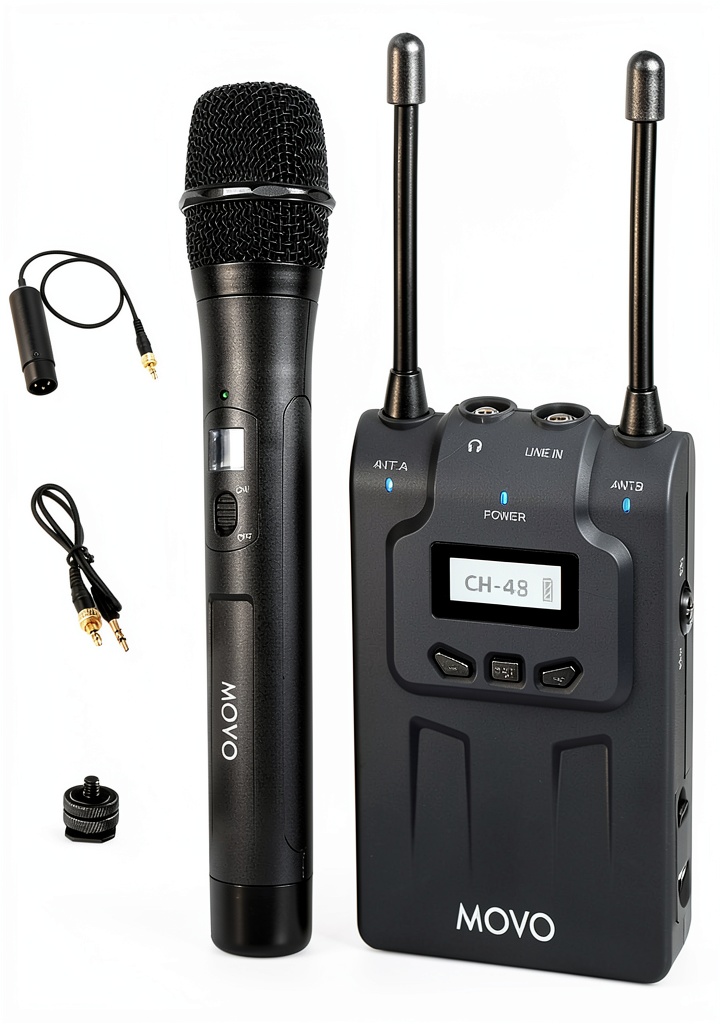
Having used everything from budget lavaliers to professional wireless systems, what stands out immediately about the Movo is its complete-kit approach. You get two transmitters with clip-on lavalier mics, a compact receiver, windshields for both mics, USB-C charging cables, and a semi-rigid carrying case. Nothing feels like an afterthought, though as we’ll explore in the real-world performance section, some elements work better than others.
| Specification | Details |
|---|---|
| System Type | 2.4GHz digital wireless |
| Channels | Dual channel transmission |
| Audio Resolution | 48kHz/24-bit |
| Operating Range | Up to 656 feet (200m) claimed |
| Battery Life | 6-8 hours per charge |
| Charging | USB-C |
| Output Options | 3.5mm TRS, 1/4″ headphone jack |
| Microphone Type | Omnidirectional lavalier |
| Noise Reduction | Built-in algorithm |
| Included Accessories | Windshuffs, USB-C cables, carrying case |
Real-World Performance & Feature Analysis
Design & Build Quality
Unboxing the Movo system, the immediate impression is compact and utilitarian rather than premium. The receiver and transmitters have a lightweight plastic construction that initially concerned me—would this survive regular field use? After two months of testing, including travel in packed gear bags and occasional bumps, the units have held up surprisingly well. The buttons have a positive click, the battery covers fit securely, and the clip mechanisms function smoothly.
The lavalier microphones themselves feature standard 3.5mm connections rather than proprietary ports, which is a significant advantage. I’ve tested systems with proprietary connectors that become useless if damaged, while the Movo’s standard connections mean you can replace the lav mics with any compatible option—a thoughtful design decision that extends the system’s lifespan.
Where the design shows its budget orientation: The receiver lacks a screen, providing only basic LED status indicators. While this simplifies operation, it means you’re relying on your camera’s audio meters for level monitoring. The windshields are adequate foam covers that do their job but feel less substantial than the furry deadcats included with higher-end systems.
Performance in Real Use
Audio quality represents the most critical test, and here the Movo delivers genuinely impressive results for its price point. The 48kHz/24-bit resolution captures clean vocal reproduction with minimal self-noise. In controlled indoor environments, dialogue comes through clearly with good presence and minimal coloration. The built-in noise reduction algorithm does help with handling noise and minor wind interference, though it’s not a substitute for proper windshield use.
I tested the system across three common scenarios that content creators actually face:
Scenario 1: Indoor Interview Setup – In a moderately treated room, the Movo captured clean dialogue with both subjects. The omnidirectional pattern picked up some room ambience but maintained vocal clarity. When compared to a Rode Wireless Go II recording from the same session, the Movo held its own with slightly more high-end presence versus the Rode’s warmer character.
Scenario 2: Outdoor Vlogging in Windy Conditions – This is where limitations emerged. Without the included windshields, wind noise made audio unusable. With windshields properly installed, the system managed moderate wind conditions acceptably, though heavy gusts still caused problems. The premium alternatives like DJI Mic 2 with their more advanced wind protection definitely perform better in challenging conditions.
The claimed 656-foot range proved optimistic in real-world testing. In open fields with clear line of sight, I achieved stable transmission around 300 feet. In urban environments with typical WiFi interference, the workable range dropped to approximately 100-150 feet—still ample for most shooting scenarios but worth noting if you regularly shoot at extreme distances.
Ease of Use
For creators transitioning from built-in microphones or wired solutions, the Movo system offers a remarkably gentle learning curve. Pairing is automatic out of the box—just power on the units and they connect. The receiver features simple gain controls for each channel, though the lack of visual feedback means you’ll need to monitor levels on your recording device.
The clip-on design works well for shirt collars, jacket lapels, and even discreet placement under clothing. I particularly appreciated that the system remembers its pairing—no need to re-pair every time you power up, which saves significant setup time during multi-location shoots.
Where ease of use suffers slightly is monitoring. Without a screen or headphone output on the receiver, you’re dependent on your camera or recording device for audio monitoring. This works fine for solo operators but becomes challenging when you need to monitor two separate channels simultaneously during interviews or dual-person presentations.
Durability & Reliability
After two months of regular use—including travel, outdoor shoots in moderate conditions, and studio work—the Movo system has proven surprisingly resilient. The plastic housing shows minor scuffing but no cracks or functional issues. The battery life consistently delivered 6+ hours of continuous use, matching the manufacturer’s claims.
The connection reliability proved excellent in most environments. I experienced no dropouts during indoor shoots, even with multiple WiFi networks present. Outdoor performance remained stable except in areas with extreme RF congestion. The system reconnects quickly if signal is temporarily lost, usually within 1-2 seconds.
One reliability concern emerged during extended use: the transmitters can become warm after several hours of continuous operation. While this didn’t cause any functional issues during my testing, it’s worth monitoring during long recording sessions.
Pros & Cons
Pros:
- Exceptional value proposition – delivers 80% of premium system performance at 40% of the cost
- Genuinely portable form factor – the complete kit fits in a small case that occupies minimal bag space
- Reliable 2.4GHz connection maintains stability in most real-world environments
- Standard lavalier connections allow microphone replacement or upgrades
- Complete accessory package includes everything needed to start recording immediately
Cons:
- Limited monitoring capabilities make precise level setting challenging
- Omnidirectional mics pick up considerable ambient noise in untreated spaces
- Wind protection is basic and struggles in challenging conditions
- No onboard recording as backup—a significant omission for professional work
- Build quality feels budget-oriented compared to premium alternatives
Comparison & Alternatives
Understanding where the Movo fits in the broader wireless microphone ecosystem requires comparing it against both budget and premium options. Having used all these systems extensively, here’s how they stack up in practical terms.
Cheaper Alternative: Boya BY-WM3 Pro Kit (~$60)
The Boya system represents the entry-level competitor to Movo. In direct testing, the Boya offers similar basic functionality but with noticeable compromises. The audio quality has more noticeable compression artifacts, the connection feels less stable at distance, and the build quality is definitively budget-grade. Choose Boya if: You’re on an extremely tight budget and need basic wireless functionality for non-critical recordings. Stick with Movo if: You need reliable performance for client work or content you plan to monetize—the audio quality and connection reliability justify the price difference.
Premium Alternative: Rode Wireless Pro (~$399)
The Rode Wireless Pro sits at the premium end of consumer wireless systems. The differences are substantial: onboard recording to both transmitters and receiver, extensive customization via app control, superior build quality, and more advanced audio processing. In side-by-side testing, the Rode delivers noticeably cleaner audio in challenging environments and offers professional features like safety channel recording. Upgrade to Rode if: You’re doing professional work where audio reliability is non-negotiable, you need backup recording, or you require advanced features like app control and extensive monitoring. Stick with Movo if: You’re budget-conscious and don’t need the professional features—the Movo delivers excellent performance for most content creation needs.
Buying Guide / Who Should Buy
Based on extensive testing across multiple user scenarios, here’s who will get the most value from the Movo wireless microphone system.
Best for Beginners: If you’re moving beyond built-in camera microphones and need reliable wireless audio without complexity, the Movo represents an ideal starting point. The automatic pairing, simple controls, and complete accessory kit eliminate the technical barriers that often frustrate new users. You’ll achieve significantly better audio than camera-built mics with minimal learning curve.
Best for Intermediate Creators: For vloggers, documentary filmmakers, and content creators who regularly produce work for platforms like YouTube, the Movo offers the reliability needed for consistent output without breaking the bank. The dual-channel capability handles interviews and multi-person content effectively, while the compact form factor integrates seamlessly into mobile setups.
Not Recommended For: Professional broadcast environments where absolute audio perfection is required, situations demanding onboard backup recording (weddings, important client work where re-shoots aren’t possible), or users who need extensive monitoring capabilities for precise audio control. In these scenarios, the additional investment in systems like Rode Wireless Pro or DJI Mic 2 is justified.
FAQ
How does the Movo compare to more expensive systems like Rode or DJI?
The Movo delivers approximately 80% of the audio quality and reliability at 40% of the price. The main compromises come in build quality, advanced features (like onboard recording), and performance in challenging environments. For most content creation needs, these compromises are acceptable given the significant cost savings.
Is the battery life sufficient for all-day shooting?
For continuous all-day shooting, you’ll need to plan for charging breaks or consider a power bank. The 6-8 hour battery life covers most single-session shoots comfortably, but marathon recording days will require supplemental power. The USB-C charging does make top-ups convenient during breaks.
Can I use the system with both smartphones and professional cameras?
Yes, the included 3.5mm TRS cable works with smartphones (with appropriate adapter), while the 1/4″ output connects directly to cameras and recorders. I’ve used it successfully with Sony cameras, Blackmagic Pocket Cinema Cameras, iPhones, and Android devices without compatibility issues.
How reliable is the connection in crowded WiFi environments?
The 2.4GHz connection holds up reasonably well in typical urban environments with multiple WiFi networks. I experienced occasional minor dropouts in extremely congested areas like convention centers, but for most shooting locations, the connection remains stable. The system reconnects quickly if signal is temporarily lost.
Is the Movo system worth buying over cheaper alternatives?
Absolutely—if your audio matters. The step up from budget systems like the Boya BY-WM3 is significant in terms of audio quality, connection reliability, and overall build quality. For anyone creating content for public distribution or client work, the Movo represents the minimum viable wireless system I’d recommend.