Table of Contents
- Key Takeaways
- Quick Verdict
- Product Overview & Specifications
- Real-World Performance & Feature Analysis
- Design & Build Quality
- Performance in Real Use: Two Scenarios
- Ease of Use
- Durability & Reliability
- Pros & Cons
- Comparison & Alternatives
- Cheaper Alternative: There Isn’t One (And That’s the Point)
- Premium Alternative: Canon EF 70-300mm f/4-5.6 IS II USM
- Buying Guide / Who Should Buy
- Best for Beginners on a Strict Budget
- Not Recommended for Professionals or Serious Hobbyists
- A Note for Wildlife and Sports Photographers
- FAQ
You’re browsing for an affordable telephoto lens, and the Canon EF 75-300mm f/4-5.6 III keeps popping up. It’s tempting—the price is low, the zoom range seems perfect for wildlife or your kid’s soccer games, and it has that trusted Canon logo. But you’ve also seen the whispers online: is it too good to be true?
Having shot with this lens for years, from backyard bird feeders to amateur sports fields, I can give you the unvarnished truth. This isn’t a spec-sheet rundown; it’s a practical guide based on the reality of using this lens when the light is fading and your subject is moving. We’ll cut through the hype and help you decide if this budget-friendly zoom is the right tool for your bag or if you’re better off with an alternative.
Key Takeaways
- Extreme Budget Entry Point: The 75-300mm’s primary advantage is its incredibly low cost, making it one of the cheapest ways to experiment with telephoto photography on a Canon DSLR.
- Sharpness is a Compromise: Image quality, especially at the 300mm end, is soft unless you use excellent technique and ideal lighting. This is its most significant limitation.
- No Image Stabilization is a Major Hurdle: The lack of IS means you’ll need very fast shutter speeds to avoid blurry photos, limiting its use in overcast conditions or indoors.
- Best for Casual, Well-Lit Use: It can produce decent results for casual wildlife, daylight sports, or portraits when you understand and work within its limitations.
- An Upgrade is Often Worth Saving For: For most serious hobbyists, investing a bit more in a used or refurbished image-stabilized lens like the Canon EF 70-300mm IS USM provides a dramatically better experience.
Quick Verdict
Best for: Absolute beginners on a tight budget who want to dabble in telephoto photography in bright sunlight. Think casual backyard birding, daytime sports from the stands, or vacation photos where size and weight are priorities.
Not ideal for: Low-light photography, serious wildlife shooting, or anyone who expects pro-level sharpness. If you frequently shoot in overcast weather or indoor sports, the lack of image stabilization will be a constant frustration.
Core Strengths: Extremely affordable, very lightweight and compact, provides a long reach for the price, fully compatible with all Canon EF-mount DSLRs.
Core Weaknesses: Soft image quality at 300mm, no image stabilization, slow and noisy autofocus, prone to chromatic aberration in high-contrast scenes.
Product Overview & Specifications
The Canon EF 75-300mm f/4-5.6 III is an entry-level telephoto zoom lens that has been in Canon’s lineup for decades, a testament to its role as a gateway to long-reach photography. It’s a simple lens optically, with no advanced features like image stabilization or ultrasonic autofocus. This simplicity is the key to its low price. The variable aperture means that as you zoom in, the maximum amount of light the lens can gather decreases (f/4 at 75mm to f/5.6 at 300mm), which is a common trait in budget zooms.
| Specification | Details |
|---|---|
| Focal Length | 75-300mm |
| Maximum Aperture | f/4-5.6 |
| Minimum Aperture | f/45 |
| Lens Construction | 9 elements in 7 groups |
| Closest Focusing Distance | 1.5m (4.9 ft) |
| Filter Size | 58mm |
| Maximum Magnification | 0.25x |
| Dimensions | 71mm diameter x 122mm length |
| Weight | 480g (16.9 oz) |
| Image Stabilization | No |
Real-World Performance & Feature Analysis
Design & Build Quality
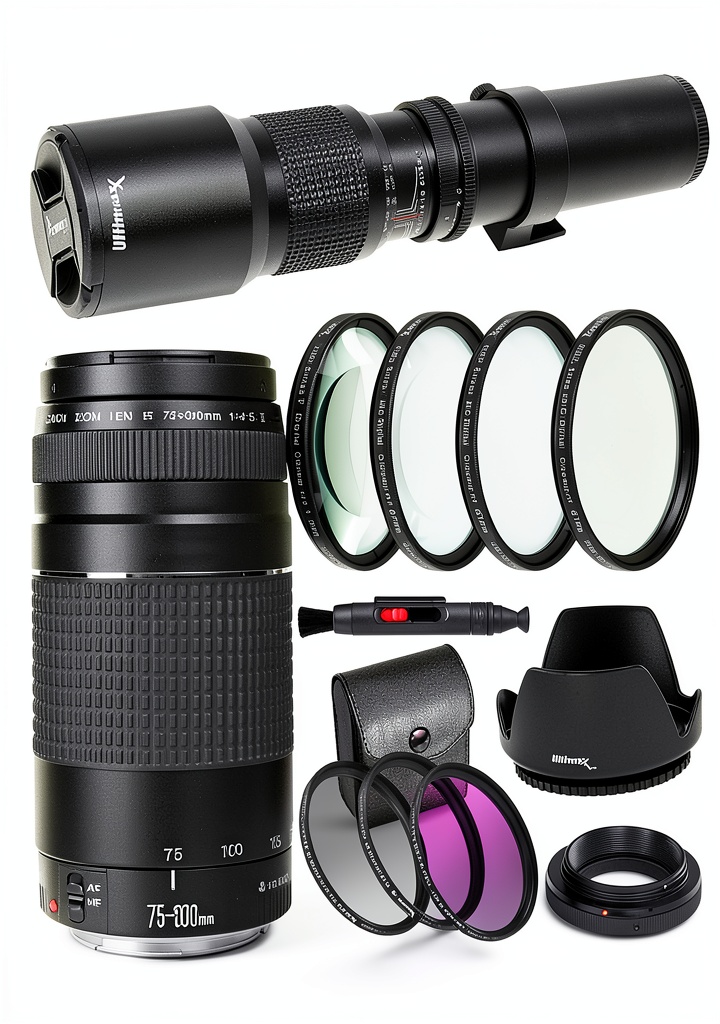
Pick up the 75-300mm, and the first thing you notice is how light it is. At under 500 grams, it feels almost hollow compared to professional telephotos. The build is entirely plastic, including the lens mount. This is a major point of concern for long-term durability. While it keeps the weight down, I’ve always been careful when attaching it to my camera, as the plastic mount feels less secure than a metal one. The zoom and focus rings are narrow and plastic, offering decent but not silky-smooth operation. It feels like what it is: an entry-level kit lens, but for the telephoto range. It’s not built for rough weather or heavy abuse, but for careful, casual use, it’s perfectly adequate.
Performance in Real Use: Two Scenarios
Scenario 1: Backyard Wildlife on a Sunny Afternoon
On a bright, sunny day, this lens can be surprisingly fun. I’ve used it to photograph birds at a feeder from about 20 feet away. At around 200mm and f/8, with the sun at my back, the results are acceptable for sharing online. The autofocus, while noisy, will often lock on. However, push it to 300mm, and the flaws become apparent. The image gets noticeably softer. To get a sharp shot, you need a very fast shutter speed (1/500s or higher) because any camera shake is magnified at this focal length. This is the lens’s sweet spot: stationary or slow-moving subjects in abundant light.
Scenario 2: An Overcast Day at a Youth Soccer GameThis is where the lens struggles profoundly. The variable aperture is already at f/5.6 when zoomed in, letting in less light. On an overcast day, your camera will be fighting for light, forcing you to raise the ISO, which introduces noise. The lack of image stabilization means you can’t handhold at slower shutter speeds without motion blur. To freeze the action of running players, you need a fast shutter speed, which in low light becomes nearly impossible without grainy, high-ISO images. The slow autofocus also has a hard time tracking moving subjects consistently. This scenario highlights the lens’s biggest limitations.
Ease of Use
For a beginner, the lens is straightforward. There are no complex switches or modes. However, its ease of use is deceptive. To get good results, your technique must be excellent. You need to master the concept of the “handholding rule” (shutter speed should be 1/focal length or faster) and understand how to manipulate ISO and aperture to maintain that speed. Because it’s not stabilized, every tiny movement of your hands is amplified. Leaning against a tree or using a monopod can make a world of difference. It’s an easy lens to mount and shoot with, but a difficult lens to master.
Durability & Reliability
This lens is not built for the long haul under heavy use. The plastic construction is a point of failure. I’ve seen reports of the zoom mechanism becoming loose or gritty over time. That said, for a photographer who uses it occasionally and treats it gently, it can last for years. It’s reliable in the sense that it will function, but it’s not a workhorse. If you’re a professional or plan to use a lens frequently in demanding environments, this is not the tool for the job. Its reliability is conditional on careful handling.
 Canon EF 75-300mm f/4-5.6 III Lens Telephoto Zoom Black shown next to a DSLR camera on a photographer’s workspace” />
Pros & Cons
Pros:
- Extremely Affordable: It’s the least expensive way to get a 300mm reach for a Canon DSLR.
- Lightweight and Portable: Easy to carry all day without adding significant weight to your bag.
- Good Focal Range for Beginners: The 75-300mm range is versatile for a variety of subjects.
- Decent Center Sharpness at Shorter Focal Lengths: At 75-200mm and stopped down to f/8, sharpness is acceptable.
Cons:
- Soft at 300mm: Image quality degrades significantly at the long end of the zoom.
- No Image Stabilization: A critical flaw that limits usability in anything but bright light.
- Slow and Noisy Autofocus: The DC micro-motor is outdated and struggles with moving subjects.
- Prone to Chromatic Aberration: Purple and green fringing is common in high-contrast areas.
- Plastic Lens Mount: Feels less secure and durable than a metal mount.
Comparison & Alternatives
It’s impossible to judge the 75-300mm in a vacuum. Here’s how it stacks up against common alternatives.
Cheaper Alternative: There Isn’t One (And That’s the Point)
Honestly, there are very few new telephoto zooms cheaper than the 75-300mm. Its main competition in this price bracket is the used market. You might find an older version of this same lens or a similar third-party lens for a few dollars less, but the performance will be nearly identical. The 75-300mm’s value proposition is that it’s the absolute bottom-rung price for a new telephoto. If your budget cannot exceed $200 for a new lens, this is essentially your only option.
Premium Alternative: Canon EF 70-300mm f/4-5.6 IS II USM
This is the lens you should seriously consider saving for. It usually costs 2-3 times more, but the difference is night and day.
- Image Stabilization: The IS system allows you to shoot at shutter speeds 3-4 stops slower, meaning you can use it in overcast conditions and indoors. This is a game-changer.
- Superior Autofocus: The Ultrasonic Motor (USM) is fast, nearly silent, and more accurate for tracking.
- Better Sharpness: Overall image quality, especially at 300mm, is significantly improved.
- Build Quality: Features a metal lens mount and better overall construction.
When to choose the 70-300mm IS II: If you are at all serious about photography and plan to use the lens regularly, the extra investment is worth every penny. It’s the difference between a lens you fight with and a lens that helps you get the shot.
Buying Guide / Who Should Buy
Best for Beginners on a Strict Budget
If you’re new to photography, own a Canon Rebel or similar entry-level DSLR, and want to see if you enjoy telephoto shooting without a major financial commitment, this lens can serve as a low-risk experiment. It teaches you the importance of technique. Just know its limits from the start.
Not Recommended for Professionals or Serious Hobbyists
If your income or reputation depends on image quality, or if you’ve moved beyond the basics, this lens will disappoint. The optical limitations and lack of professional features will hinder your work. You need a tool that performs reliably in a wider range of conditions.
A Note for Wildlife and Sports Photographers
While the focal range seems ideal, the performance in the challenging light typical of these genres (early morning, late evening, under stadium lights) is poor. You will miss shots due to slow autofocus and the need for extremely high ISO settings. A used lens with image stabilization is a much better starting point.
FAQ
Is the Canon 75-300mm lens good for wildlife photography?
It can be, but with major caveats. For casual wildlife photography in bright, midday sun with stationary or slow-moving subjects, it’s passable. For serious wildlife photography, where light is often low and subjects are fast-moving, it is not recommended due to its softness at 300mm and lack of image stabilization.
What is the main difference between the 75-300mm and the 55-250mm IS?
The most significant difference is image stabilization. The EF-S 55-250mm IS STM is a crop-sensor lens that doesn’t reach 300mm, but it has excellent IS and a much sharper, quieter STM motor. For owners of APS-C Canon cameras (like Rebels), the 55-250mm is almost universally considered a far better lens, despite the shorter reach, because it’s so much more usable in real-world conditions.
Why is this lens so criticized by photographers?
It’s criticized because it’s often a beginner’s first telephoto, and its limitations can lead to frustration and blurry photos. Many photographers expect a lens with “300mm” on it to deliver sharp, professional results, which this lens cannot do. The criticism comes from the gap between expectations (set by the focal length) and reality (the optical quality at that focal length).
Is the Canon 75-300mm worth it in 2026?
Its value is entirely dependent on your budget and expectations. If $200 is your absolute max for a new lens and you understand you’re buying a tool with significant limitations for use in ideal conditions, then it has a place. However, for most people, spending a bit more on a used Canon 70-300mm IS USM or the EF-S 55-250mm IS STM provides a dramatically better photographic experience and is a wiser long-term investment.
 Vivitar T-Mount Adapter Canon EF-M Mount Lens Telescope