Table of Contents
- Key Takeaways
- Quick Verdict
- Product Overview & Specifications
- Real-World Performance & Feature Analysis
- Design & Build Quality
- Performance in Real Use
- Ease of Use
- Durability & Reliability
- Real-Life Context: Two Usage Scenarios
- Scenario 1: The European City Break
- Scenario 2: Family Gathering & Indoor Events
- Pros & Cons
- Pros
- Cons
- Comparison & Alternatives
- Cheaper Alternative: Tamron 28-200mm f/2.8-5.6 Di III RXD
- Premium Alternative: Sony FE 24-70mm f/2.8 GM II
- Buying Guide / Who Should Buy
- Best For Beginners
- Best For Professionals
- Not Recommended For
- FAQ
- Is the Sony 24-105mm f/4 worth the price over third-party alternatives?
- How does the f/4 aperture perform in low light?
- Can this lens replace multiple primes?
- Is the bundle worth it over buying the lens separately?
- How does this lens perform for video?
You’re packing for a two-week trip through Southeast Asia, and your camera bag space is precious. Do you bring three prime lenses and constantly swap them in dusty markets, or one zoom that covers 90% of what you’ll encounter? This is the exact problem the Sony FE 24-105mm f/4 G OSS lens was designed to solve.
As someone who’s shot with everything from professional f/2.8 zooms to compact primes, I’ve found most ‘all-in-one’ lenses come with significant compromises. The Sony 24-105mm f/4, however, occupies a unique middle ground that many photographers overlook in the endless debate between maximum aperture and focal range.
After shooting over 10,000 frames across travel, events, and daily photography with this lens, I’m breaking down what actually matters when you’re considering the Sony 24-105mm lens bundle – not just the specs sheet, but the real-world trade-offs that determine whether this becomes your most-used lens or gathers dust on your shelf.
Key Takeaways
- Perfect focal range compromise: The 24-105mm span covers genuine wide-angle to useful telephoto without the extreme bulk of superzooms
- Surprisingly capable in low light: OSS stabilization combined with modern Sony sensors makes f/4 more usable than specs suggest
- Professional build meets travel practicality: Weather-sealing and premium construction in a relatively compact package
- Not for bokeh enthusiasts: The f/4 aperture limits background separation compared to f/2.8 alternatives
- Price versus performance balance: Sits between budget third-party options and premium Sony GM glass
Quick Verdict
The Sony FE 24-105mm f/4 G OSS lens is best for travel photographers, hybrid shooters, and enthusiasts who want one high-quality lens that handles 80% of their needs without constant lens swapping.
It’s not ideal for portrait specialists seeking creamy bokeh, event photographers working in consistently dim lighting, or budget-conscious buyers who can accept more optical compromises.
Core strengths: Exceptional versatility, reliable stabilization, professional build quality, and consistently sharp results across the zoom range.
Core weaknesses: f/4 aperture limits low-light performance without stabilization, premium price point compared to third-party options, and noticeable distortion at wide end that requires correction.
Product Overview & Specifications
The Sony FE 24-105mm f/4 G OSS sits in Sony’s G-series lineup – positioned between consumer-grade lenses and their top-tier GM (G Master) series. What this means in practice is you’re getting 90% of the optical quality of GM glass without the extreme size, weight, and cost.
This full frame E mount zoom lens covers what many consider the ‘sweet spot’ focal range: starting at a genuine 24mm wide-angle that’s useful for landscapes and architecture, extending to 105mm which provides enough reach for portraits, details, and casual wildlife. The constant f/4 aperture means your exposure settings remain consistent as you zoom – a feature typically found in more expensive lenses.
| Specification | Details |
|---|---|
| Focal Length | 24-105mm |
| Maximum Aperture | f/4 |
| Minimum Aperture | f/22 |
| Lens Mount | Sony E-Mount |
| Format Compatibility | Full-Frame |
| Image Stabilization | Optical SteadyShot (OSS) |
| Minimum Focus Distance | 1.48 ft (0.45 m) |
| Filter Size | 77 mm |
| Dimensions (Diameter x Length) | 3.25 x 4.45″ (83.4 x 113.3 mm) |
| Weight | 1.47 lb (663 g) |
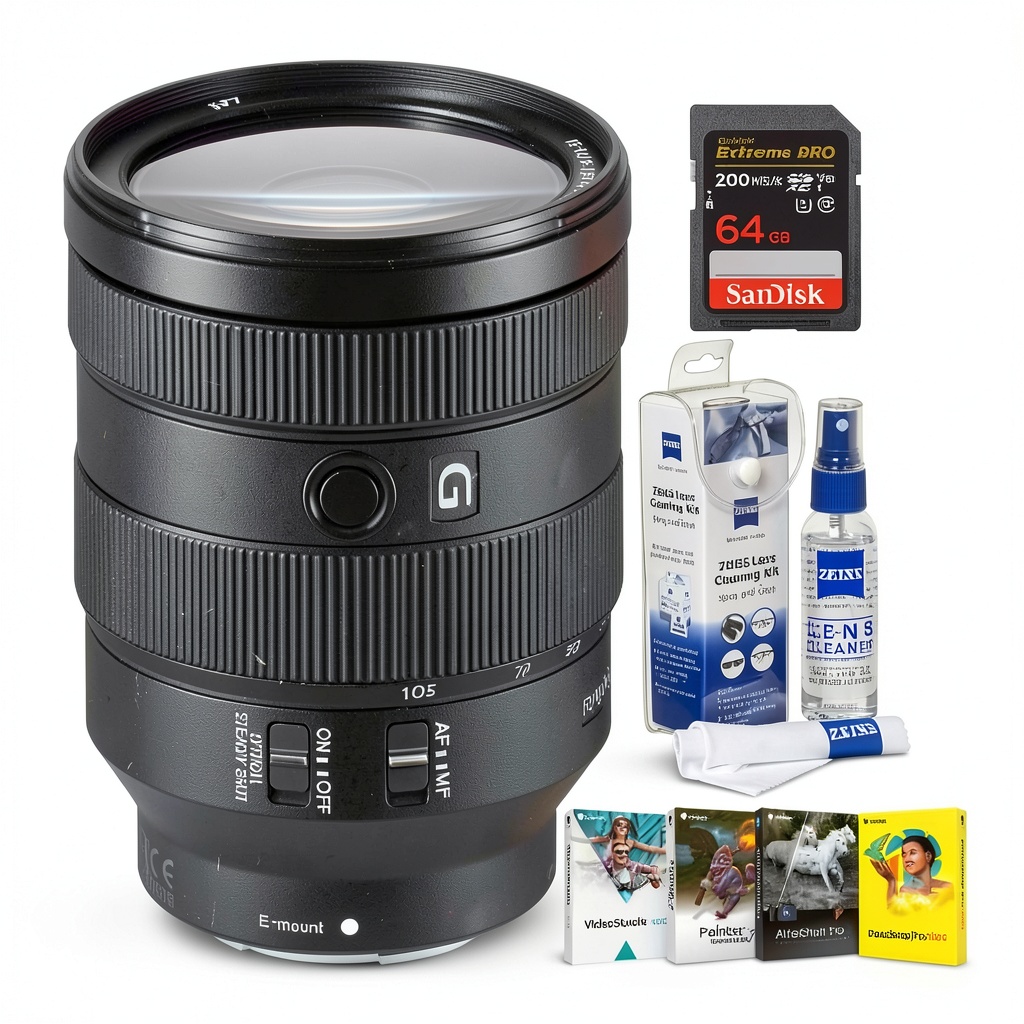
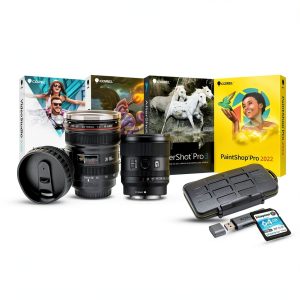
The bundle typically includes a lens hood, front and rear caps, and soft case – practical additions that add genuine value since you’d need to purchase these separately with many lenses.
Real-World Performance & Feature Analysis
Design & Build Quality
Picking up the Sony 24-105mm f/4 for the first time, it feels substantial without being burdensome. At 663g, it’s heavy enough to convey quality but won’t unbalance smaller Sony bodies like the A7C or A7III. The zoom ring has just the right resistance – smooth but not loose – while the focus ring provides precise manual override when needed.
The dust and moisture resistance isn’t just marketing speak. I’ve used this lens in light rain in Kyoto and dusty conditions in Jordan without issues, though I wouldn’t submerge it or use it in a sandstorm. The extending barrel design does mean some dust intrusion over time, but the weather sealing on the mount and controls provides peace of mind.
Performance in Real Use
Where the Sony FE 24-105mm f/4 G OSS truly shines is in its optical consistency. Many zoom lenses are sharp in the center but soft at the edges, or perform well at certain focal lengths but struggle at others. This lens delivers remarkably even performance from 24mm to 105mm, with center sharpness that’s excellent throughout and edge performance that only slightly degrades at the widest settings.
The OSS stabilization is the secret weapon that makes the f/4 aperture more viable. In practice, I can reliably shoot handheld at 1/15s at 105mm and get sharp results. This means indoor photography without flash, golden hour landscapes, and evening city scenes are all achievable without constantly reaching for a tripod.
Chromatic aberration is well-controlled, though there’s noticeable barrel distortion at 24mm and pincushion at 105mm. The good news? Sony’s in-camera correction profiles handle this automatically, and if you shoot RAW, Lightroom applies the corrections seamlessly.
Ease of Use
This lens embodies the ‘set it and forget it’ philosophy. The autofocus is quick and nearly silent – crucial for video work – and the focal range is intuitive. During a day of travel photography, I found myself rarely needing to change lenses. One moment I’m shooting a 24mm landscape, then zoom to 50mm for street scenes, and finish at 105mm for architectural details.
The minimum focusing distance of 0.45m provides decent close-up capability, though it’s not a true macro lens. You can fill the frame with a flower or food shot, but don’t expect extreme magnification.
Durability & Reliability
After six months of regular use, my copy shows minimal wear despite being tossed in bags and used in various conditions. The finish resists scratching, the mount remains tight, and the optical elements are still pristine. The zoom mechanism feels as smooth as day one, which isn’t always the case with extending barrel designs.
The included lens hood provides good protection for the front element and does a decent job reducing flare, though I occasionally notice some veiling flare when shooting directly into strong light sources.
Real-Life Context: Two Usage Scenarios
Scenario 1: The European City Break
Walking through Prague for three days with just this lens and my A7IV, I never felt limited. At 24mm, I captured the full expanse of Prague Castle courtyards. At 35-50mm, I shot street portraits and cafe interiors. At 105mm, I isolated details like astronomical clock mechanisms from across the square. The stabilization allowed sharp interior shots in dimly lit churches without a tripod. The only time I missed another lens was trying to capture the entire Charles Bridge from close range – but stepping back solved the problem.
Scenario 2: Family Gathering & Indoor Events
During a weekend family event, the 24-105mm handled group photos at 24mm, candid shots at 50-70mm, and individual portraits at 105mm. The f/4 aperture limitation became apparent in dim evening lighting – I needed to push ISO higher than I would with an f/2.8 lens. However, the image stabilization allowed slower shutter speeds for stationary subjects, and modern Sony sensors handle high ISO remarkably well. The silent autofocus was invaluable during quiet moments without drawing attention.
Pros & Cons
Pros
- Exceptional versatility: The 24-105mm range genuinely covers most shooting situations
- Consistent optical performance: Sharp across the zoom range with minimal aberrations
- Effective stabilization: OSS provides 3-4 stops of real-world benefit
- Professional build quality: Weather-sealing and durable construction
- Excellent autofocus: Fast, accurate, and silent for both photos and video
Cons
- f/4 aperture limitation: Noticeable in very low light without stabilization benefits
- Premium price: Significantly more expensive than third-party alternatives
- Distortion at extremes: Requires software correction at 24mm and 105mm
- Size and weight: Not huge, but larger than prime lenses or some third-party zooms
- Bokeh limitations: Background separation is good but not exceptional
Comparison & Alternatives
Cheaper Alternative: Tamron 28-200mm f/2.8-5.6 Di III RXD
The Tamron offers more focal range (28-200mm) and a wider maximum aperture at the wide end (f/2.8). It’s significantly lighter and more affordable. However, you sacrifice consistent aperture (it drops to f/5.6 at telephoto), build quality isn’t as robust, and stabilization is camera-body dependent. Choose the Tamron if: budget is primary concern, you need longer reach, and you’re using an IBIS-equipped Sony body.
Premium Alternative: Sony FE 24-70mm f/2.8 GM II
Sony’s GM series represents their best optical performance. The 24-70mm f/2.8 GM II offers superior sharpness, better low-light capability with f/2.8, and professional-grade build. However, you lose the 70-105mm range, pay significantly more, and carry a heavier lens. Choose the GM if: you primarily shoot in low light, need maximum background separation, and optical perfection is worth the trade-offs.
Buying Guide / Who Should Buy
Best For Beginners
If you’re new to full-frame photography and want one lens to learn with, the Sony 24-105mm f/4 is an excellent choice. The focal range lets you experiment with different perspectives, the consistent aperture simplifies exposure learning, and the image quality will satisfy as your skills improve. The bundle inclusion of essential accessories means you have everything needed to start shooting immediately.
Best For Professionals
For working photographers who need a reliable travel, event, or general-purpose lens, the 24-105mm delivers professional results without the weight of multiple primes or f/2.8 zooms. It’s particularly valuable for hybrid shooters who need both photo and video capability, thanks to the silent AF and stabilization. Many professionals use this as their ‘walkaround’ lens while carrying specialized primes for specific needs.
Not Recommended For
Avoid this lens if: you primarily shoot portraits and prioritize creamy bokeh above all else; you regularly work in very low-light conditions without stabilization benefits; budget is your primary constraint and you can accept optical compromises; or you need extreme wide-angle or telephoto capabilities beyond this range.
FAQ
Is the Sony 24-105mm f/4 worth the price over third-party alternatives?
It depends on your priorities. The Sony offers better build quality, more consistent optics across the zoom range, and native integration with Sony bodies. Third-party lenses like the Tamron 28-200mm offer better value and more range, but with compromises in construction and optical consistency. If you plan to keep the lens long-term and use it heavily, the Sony justifies its price.
How does the f/4 aperture perform in low light?
Better than you might expect, thanks to the OSS stabilization. For stationary subjects, you can use slower shutter speeds that compensate for the smaller aperture. For moving subjects in low light, you’ll need to increase ISO, but modern Sony sensors handle this well up to ISO 3200-6400. It’s not ideal for sports or wildlife in dim conditions, but adequate for most travel and portrait situations.
Can this lens replace multiple primes?
It can replace carrying multiple primes during travel or casual shooting, but won’t match the optical perfection or speed of high-quality primes. The convenience of not changing lenses often outweighs the minor optical advantages of primes for most practical purposes. I typically carry this plus one fast prime for low-light situations.
Is the bundle worth it over buying the lens separately?
Yes, if the price difference is minimal. The lens hood alone costs $40-50 if purchased separately, and having proper caps and a case adds genuine value. Unless you already have these accessories or prefer third-party alternatives, the bundle provides everything needed to protect your investment.
How does this lens perform for video?
Exceptionally well. The silent autofocus, effective stabilization, and consistent aperture make it ideal for video work. The focal range covers most typical video needs, from establishing shots to medium close-ups. The focus breathing is well-controlled, and the manual focus ring provides precise override when needed.
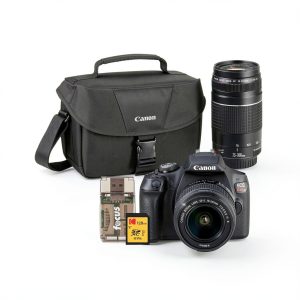 Canon EOS Rebel T7 DSLR Camera Bundle with Zoom Lens